


Low-temperature treatment plays a crucial role in determining how nano alumina behaves during ceramic processing, influencing its microstructure, surface chemistry, and reactivity. In modern ceramic manufacturing, particle size distribution, mean particle size, and spray drying conditions work together with thermal conditioning to define how nano alumina disperses, sinters, and contributes to the final material properties. This article provides a structured analysis of how low-temperature treatment modifies nano alumina and how these changes affect its performance in ceramic applications. Drawing from scientific principles and production data, we will examine the underlying mechanisms, quantitative indicators, processing pathways, and industrial implications to give a complete and SEO-friendly exploration suitable for a ceramic-focused website.
At Heeger Materials Inc., we specialize in high-quality nano alumina products, ensuring optimal performance for industrial and scientific applications.
What Is Nano Alumina and Why Do Its Particle Features Matter?
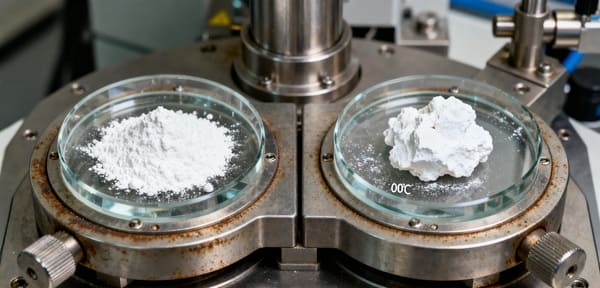
Nano alumina is a finely engineered aluminum oxide powder with particle sizes typically in the 20–200 nm range. Its high surface area enables strong interactions during sintering and dispersion, but it also makes the powder highly sensitive to temperature-induced changes. Understanding the relationship between low-temperature treatment and particle size, mean particle size, and spray drying history is essential for predicting downstream behavior in ceramic forming.
Typical Characteristics of Nano Alumina Powders
Property | Typical Value | Influence on Performance |
Particle size (nm) | 50–150 | Determines reactivity and diffusion rates |
Mean particle size (μm after spray drying) | 10–60 | Affects granule packing and flowability |
Specific surface area (m²/g) | 20–80 | Governs adsorption and sintering onset |
Crystal phase | γ → α transitions | Controls microstructural stability |
Low-temperature treatment influences these parameters by modifying water content, defect density, and surface hydroxylation. Before more intense thermal events occur, small adjustments in these surface factors can have measurable effects during shaping and sintering, affecting how the powder flows, compacts, and reacts with binders.
Explore our high-quality nano alumina products.
How Does Low-Temperature Treatment Change the Microstructure of Nano Alumina?
Low-temperature treatment (typically 80–400 °C) induces several microstructural modifications before any major phase transition occurs. These changes mainly involve the removal of physically and chemically bonded water, relaxation of surface defects, and adjustments in particle-to-particle interactions. Even though the temperature is low, the microstructural rearrangements can significantly influence powder handling and reactivity.
Key Microstructural Changes Under Low-Temperature Treatment
- Reduction of surface hydroxyl groups decreases moisture-induced agglomeration.
- Improved granule roundness after spray drying due to reduced capillary forces.
- Partial relaxation of grain boundary defects without altering core crystallinity.
- More uniform interparticle spacing, enabling more predictable compaction behavior.
Altogether, these microstructural adjustments reduce uncontrolled clustering and improve the consistency of powder packing. This facilitates more stable ceramic processing, especially when tight control over density and porosity is required.
Why Does Low-Temperature Treatment Affect the Reactivity of Nano Alumina?
The surface reactivity of nano alumina originates from defects, hydroxyl groups, and a large surface area. Low-temperature treatment modifies these factors, leading to measurable changes in chemical reactivity and sintering behavior. The removal of water and surface groups alters the powder’s re-adsorption behavior, dispersibility, and interfacial bonding with additives.
Reactivity Changes Before and After Low-Temperature Treatment
Parameter | Before Treatment | After Treatment | Resulting Effect |
Surface hydroxyl density | High | Moderate | Reduced moisture sensitivity |
Zeta potential (mV) | Strongly negative | More stable | Improved dispersion control |
Agglomeration tendency | High | Lower | Better suspension stability |
Sintering onset (°C) | 900–1000 | 960–1050 | Requires slightly more energy but offers improved uniformity |
These shifts improve powder stability, making nano alumina more predictable during mixing and shaping. Although the sintering onset may increase slightly, the improved uniformity often yields better final ceramic performance.
How Does Low-Temperature Treatment Interact With Particle Size and Mean Particle Size?
Particle size and mean particle size determine how nano alumina packs and how uniformly it densifies. Low-temperature treatment interacts with these parameters by modifying surface energy and eliminating trapped moisture. Spray-dried nano alumina granules benefit from treatment because it improves granule cohesion without raising risk of hard agglomerate formation.
Effects on Particle Size–Related Behaviors
- Reduced capillary bonding prevents fine particles from fusing into hard agglomerates.
- More uniform moisture removal stabilizes granule shrinkage during pre-sintering.
- Mean particle size distribution becomes more stable due to decreased void fluctuations.
- Enhanced granule flowability improves powder feeding in ceramic presses.
These improvements are especially important in applications requiring tight tolerances, such as electronic ceramics or precision structural components. More stable particle behavior leads to more consistent green body density and fewer processing defects.
How Does Low-Temperature Treatment Influence Spray-Dried Granule Behavior?
Spray drying determines the initial geometry, density, and flowability of nano alumina granules. Low-temperature treatment further adjusts residual moisture levels, polymer binder interactions, and shell-core uniformity inside granules. These changes help minimize defects such as hollow granules, variable density, or weak bonding.
Low-Temperature Effects on Spray-Dried Granules
Feature | Untreated Granules | After Low-Temp Treatment | Benefit |
Internal moisture | Uneven | Uniform | Reduced internal cracking |
Binder distribution | Variable | Stabilized | Predictable burnout behavior |
Granule wall thickness | Irregular | More consistent | Improved pressing response |
Flowability | Medium | Higher | Better mold filling |
This additional conditioning step smooths out inconsistencies introduced during spray drying, leading to higher production stability and fewer rejections in advanced ceramic lines.
How Does Low-Temperature Treatment Affect Nano Alumina Sintering Behavior?
Although low-temperature treatment occurs far below the primary sintering range, the pre-conditioning strongly influences early-stage sintering kinetics. Modified surface chemistry and defect states can influence the diffusion mechanisms that initiate densification.
Influences on Sintering Behavior
- More uniform neck formation due to consistent interparticle cleanliness.
- Reduced exaggerated grain growth thanks to lowered defect mobility.
- A slightly higher activation energy is needed for initial diffusion.
- More homogeneous shrinkage produces fewer warpage issues.
For high-performance alumina ceramics—such as substrates, armor plates, and wear components—this predictability is advantageous, as it leads to tighter dimensional control and more reliable mechanical performance.
How Does Low-Temperature Treatment Improve Compatibility With Additives?
Nano alumina is often combined with dispersants, binders, plasticizers, and sintering aids. Low-temperature treatment modifies surface functionality, improving interactions with these additives and enhancing mixing efficiency.
Compatibility Improvements With Common Additives
Additive Type | Untreated Interaction | Post-Treatment Interaction | Improvement |
Dispersants | Over-adsorption | Balanced adsorption | Better rheology |
Binders | Irregular bonding | More uniform | Improved green strength |
Sintering aids | Poor contact | Enhanced wetting | Higher densification |
Plasticizers | Uneven distribution | More stable | Reduced cracking |
These improvements reduce processing risks and support high-yield ceramic production.
Request a custom quote for our nano alumina products.
How Does Low-Temperature Treatment Compare With Other Conditioning Methods?
Nano alumina can also be conditioned through mechanical milling, chemical surface modification, or high-temperature pre-calcination. Low-temperature treatment fills a unique role by offering surface tuning without aggressive structural alterations.
Comparison With Other Methods
- Mechanical milling reduces particle size but increases defects; low-temp treatment reduces surface defects instead.
- Chemical treatment adjusts surface chemistry but leaves residues; low-temp treatment avoids contamination.
- High-temperature calcination improves phase purity but causes grain growth; low-temp treatment preserves nanoscale size.
- Freeze drying prevents agglomeration but is costly; low-temp treatment is more economical for large-scale use.
Thus, low-temperature treatment offers a balanced and scalable approach, especially when maintaining nanoscale properties is a priority.
FAQ
Question | Answer |
Does it change crystallinity? | No major phase changes occur below ~400 °C. |
Does it reduce agglomeration? | Yes, by limiting moisture-related clustering. |
Does it affect spray-dried granules? | Yes, it improves uniformity and flowability. |
Is it necessary for all ceramic applications? | Not always, but highly beneficial for high-precision uses. |
Does it increase processing cost? | Minimal—energy requirements are relatively low. |
Conclusion
Low-temperature treatment plays a strategic role in preparing nano alumina for advanced ceramic manufacturing. By modifying moisture content, surface chemistry, and interparticle interactions, this pre-conditioning step influences particle size stability, granule behavior during spray drying, and the reactivity that governs early sintering. Through more predictable powder flow, improved compatibility with additives, and enhanced microstructural control, low-temperature treatment helps manufacturers achieve consistent quality and better final performance. When integrated into a complete processing strategy, it offers a low-cost yet impactful approach to optimizing nano alumina for high-performance ceramic applications.
Looking for high-quality nano alumina product? Contact us today!