



High-temperature structural ceramics rely heavily on the creep resistance of their microstructures, especially in applications such as turbine engines, bearings, and wear systems. Among these materials, silicon nitride ceramics stand out due to their strong covalent bonding, high thermal stability, and the ability to form interlocking β-Si₃N₄ microstructures. However, the final creep resistance of sintered silicon nitride components depends fundamentally on the quality and characteristics of the starting silicon nitride powder. Powder purity, α/β phase ratio, particle size distribution, and specific surface area determine the densification behavior, grain-boundary chemistry, grain morphology, and ultimately how the ceramic withstands time-dependent deformation under stress at high temperature.
This article explains how silicon nitride powder influences creep behavior, using scientific mechanisms and practical indicators. Each section addresses one aspect of powder properties and describes how it affects microstructure evolution and high-temperature creep performance.
At Heeger Materials Inc., we specialize in high-quality silicon nitride products, ensuring optimal performance for industrial and scientific applications.
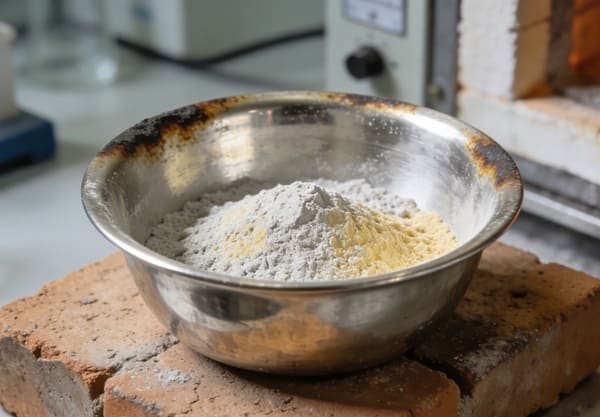
What Is High-Temperature Creep and Why Does It Matter for Silicon Nitride Ceramics?
Creep refers to the time-dependent plastic deformation of a material under constant stress and temperature—even when the applied stress is below the yield strength. In silicon nitride ceramics, creep resistance is crucial because these materials are used in extreme environments where prolonged thermal and mechanical loads occur. Understanding the three stages of creep—primary, steady-state, and tertiary—helps clarify why microstructural features such as grain interlocking, boundary viscosity, and porosity strongly influence performance.
Stages of Creep in Silicon Nitride Ceramics
Creep Stage | Characteristics | Dominant Mechanisms | Impact on Creep Resistance |
Primary | Decreasing creep rate | Dislocation hardening, grain-boundary resistance | Higher resistance as hardening increases |
Steady-State | Constant creep rate | Balance of hardening and recovery | Most critical stage for component lifetime |
Tertiary | Rapid acceleration | Porosity growth, grain-boundary cracking | Failure due to internal damage |
The steady-state creep stage dominates the operational lifetime of ceramic components. Its rate is controlled primarily by grain-boundary sliding and diffusion processes. High-quality silicon nitride powder contributes to refined, interlocking grains and stable grain-boundary phases that slow these mechanisms. This establishes the foundation for how powder characteristics translate directly into creep resistance.
Explore our high-quality silicon nitride products.
How Does Silicon Nitride Powder Purity Influence Creep Resistance?
Powder purity is one of the most decisive factors affecting creep resistance because impurities directly alter the chemistry and viscosity of grain-boundary phases. Metallic cations and excess oxygen can form low-viscosity glassy phases during sintering, reducing grain-boundary strength at high temperatures. Since creep in silicon nitride is strongly influenced by grain-boundary sliding and viscous flow, controlling impurity levels is essential for high-performance components.
Key Effects of Impurities on Creep Behavior
- Cation impurities (Ca, Fe, Na, K) form low-melting glass phases
- Higher oxygen content increases SiO₂ thickness on particle surfaces
- Excess SiO₂ reacts with sintering additives to produce more intergranular glass
- Low-viscosity grain-boundary phases accelerate grain-boundary sliding
Low impurity levels reduce the formation of unwanted intergranular glass that softens at high temperatures. High-purity silicon nitride powder, therefore, produces ceramics with stronger, more viscous grain boundaries, which significantly improve creep resistance. For demanding structural applications, ultra-low metal impurities and reduced oxygen levels are essential.
How Does α/β Phase Composition Affect Creep Resistance in Silicon Nitride Ceramics?
Silicon nitride powder typically contains α-Si₃N₄ and β-Si₃N₄ phases. A high α-phase content is strongly preferred for ceramic processing because α-Si₃N₄ dissolves into the liquid phase during sintering and precipitates as elongated β-Si₃N₄ grains—a key mechanism for developing the interlocking microstructure that enhances creep resistance. Starting powder that contains mostly β-phase cannot undergo this transformation, resulting in weaker microstructural development.
α vs β Silicon Nitride Roles in Creep Resistance
Phase Type | Characteristics | Role in Sintering | Influence on Creep Resistance |
α-Si₃N₄ | Fine, equiaxed | Dissolves and precipitates as β grains | Enables growth of interlocking β grains |
β-Si₃N₄ | Needle-like | Stable, minimal dissolution | Produces less effective grain interlocking |
A high α-phase content ensures sufficient solution–reprecipitation, forming elongated β-grains that interlock and anchor grain boundaries. This structure resists grain-boundary sliding and crack propagation, improving long-term creep resistance. Therefore, α-phase content is positively correlated with high-temperature performance.
How Do Particle Size and Particle Size Distribution Affect Creep Resistance?
Particle size determines sintering behavior, densification rate, and pore elimination. Fine powders increase surface area and sintering activity, while a broader particle-size distribution improves packing density before sintering. Both factors influence residual porosity, grain size uniformity, and microstructural integrity—all of which directly affect creep resistance in silicon nitride ceramics.
Particle Size Influence on Creep Behavior
Powder Feature | Mechanism | Result | Effect on Creep Resistance |
Fine particles | Higher SSA, faster densification | Lower porosity | Improves creep resistance |
Wide distribution | Better packing | Reduced large pores | Enhances microstructural stability |
Coarse particles | Nonuniform growth | Weak grain regions | Reduces creep resistance |
Optimized particle size and distribution promote a uniform, dense microstructure with fewer defects that can evolve into creep damage. Proper particle engineering helps produce β-Si₃N₄ grains that are fine and evenly distributed, leading to more consistent high-temperature performance. Controlled particle design is therefore essential for maximizing creep resistance.
How Does Specific Surface Area (SSA) of Silicon Nitride Powder Influence Creep Resistance?
Specific surface area (SSA) determines reactivity and sintering behavior. Higher SSA generally enhances sintering activity but also increases oxygen adsorption, which can lead to the formation of excessive intergranular glass. Thus, SSA affects creep resistance through two competing pathways: densification (positive) and oxygen-related glass formation (negative).
SSA Effects on Creep Behavior
- Higher SSA increases surface reactivity and lowers sintering temperature
- Greater surface exposure increases SiO₂ layer thickness
- Additional SiO₂ reacts with additives to create more glassy phases
- Excess low-viscosity glass weakens creep resistance
An optimal SSA balances high sintering activity with minimal oxygen-related glass formation. For creep-resistant silicon nitride ceramics, powders should have moderately high SSA but must be processed with strict oxygen control to ensure strong, stable grain boundaries. Controlled SSA helps achieve dense microstructures with improved creep resistance.
How Do Grain-Boundary Phases Formed During Sintering Affect Creep Resistance?
During sintering, additives such as Y₂O₃ and Al₂O₃ form liquid phases that assist densification and promote the transformation from α to β silicon nitride. However, the remaining intergranular phases largely determine high-temperature creep behavior. Their viscosity, thickness, and crystallization behavior regulate grain-boundary sliding, which is the primary mechanism of creep.
Grain-Boundary Phase Characteristics and Their Impact
Boundary Feature | Description | High-Temperature Effect | Creep Resistance Impact |
Glassy phase | Amorphous silicate | Low viscosity | Reduces creep resistance |
Crystalline phase | Oxynitride crystals | Higher stiffness | Improves creep resistance |
Thin boundary film | Reduced thickness | Less sliding | Enhances resistance |
Thick film | More liquid-like | More sliding | Weakens resistance |
Minimizing low-viscosity glass and promoting crystallization of boundary phases significantly improves creep resistance. Powder purity, SSA, and additive control all influence these phases, demonstrating how powder characteristics directly shape long-term performance.
Why Do Silicon Nitride Powder Characteristics Directly Determine High-Temperature Creep Resistance?
Creep resistance ultimately depends on grain strength and boundary stability. Powder characteristics shape grain growth behavior, pore elimination, grain-boundary chemistry, and the formation of interlocking microstructures. These factors collectively determine how the ceramic resists steady-state deformation over time.
Powder-to-Performance Mechanism Chain
Powder purity → grain-boundary chemistry
α-phase content → grain interlocking structure
Particle size → densification and porosity
SSA → oxygen content and reactivity
Boundary phases → viscosity and sliding resistance
The microstructure of silicon nitride ceramics is a direct reflection of powder attributes. High-quality powder enables the formation of strong, interlocking β-grain networks and highly viscous boundary phases, both of which suppress creep. Thus, powder engineering is the foundation of reliable high-temperature performance.
Request a custom quote for our silicon nitride products.
FAQ
Question | Answer |
What powder purity is recommended? | Ultra-high purity with low cation impurities (<100 ppm) and reduced oxygen. |
Why is high α-phase content preferred? | It promotes the formation of interlocking β-grains through dissolution–precipitation. |
What particle size is optimal? | Fine powders (0.2–0.6 μm) with broad distribution for high packing density. |
Does SSA matter? | Yes—moderately high SSA improves sintering, but excessive oxygen must be controlled. |
Which boundary phases are best? | Crystalline or highly viscous phases that resist grain-boundary sliding. |
Conclusion
Creep resistance in silicon nitride ceramics is fundamentally determined by the starting powder quality. Powder purity controls grain-boundary viscosity, α-phase drives interlocking β-grain formation, particle size governs densification and porosity, and SSA influences both sintering activity and oxygen content. These powder parameters collectively shape the microstructure that controls high-temperature deformation behavior. For ceramic components used in harsh thermal and mechanical environments, engineering the silicon nitride powder with precision is essential to achieving stable, long-term creep resistance.
Looking for high-quality silicon nitride product? Contact us today!