



Silicon nitride ceramics are among the most important advanced ceramic materials used in mechanical, thermal, and structural applications. However, their performance is fundamentally controlled by the behavior of the two polymorphs of silicon nitride: α-Si₃N₄ and β-Si₃N₄. Understanding the structural relationship, transformation pathway, and performance differences between these two phases is essential for selecting suitable raw powders and designing high-performance sintered components.
This article provides a comprehensive, data-driven, and scientifically structured analysis of α-Si₃N₄ vs β-Si₃N₄, focusing on how their crystal structure, formation conditions, morphology, and thermodynamic behavior ultimately impact ceramic reliability.
At Heeger Materials Inc., we specialize in high-quality silicon nitride products, ensuring optimal performance for industrial and scientific applications.
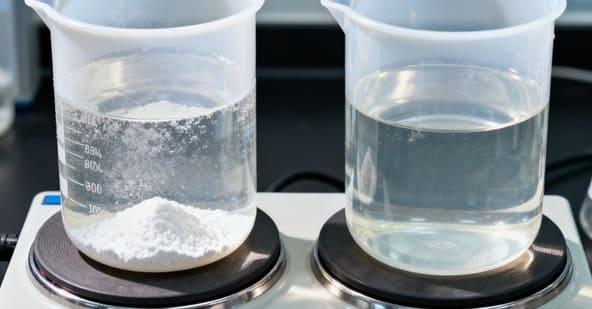
What Are the Basic Structural Differences Between α-Si₃N₄ and β-Si₃N₄?
Before examining performance, it is essential to understand the differences between α-Si₃N₄ and β-Si₃N₄ at the atomic scale. Their crystal structures define their stability, morphology, and transformation behavior during sintering. Although both belong to the hexagonal system, α-Si₃N₄ exhibits stacking variations that produce a more distorted lattice, whereas β-Si₃N₄ displays a cleaner and more ordered structure.
These structural nuances ultimately determine which phase is metastable and which is thermodynamically favored at high temperatures, making this comparison the foundation of all performance differences discussed later.
Structural comparison of α-Si₃N₄ and β-Si₃N₄
Property | α-Si₃N₄ | β-Si₃N₄ |
Crystal structure | Hexagonal (distorted) | Hexagonal (highly ordered) |
Thermodynamic stability | Metastable | Stable |
Atomic stacking | Complex, lower symmetry | Simple, higher symmetry |
Lattice energy | Higher (less stable) | Lower (more stable) |
The structural contrast shown above is the core reason behind the α → β transformation during sintering, which will be discussed in later sections. Understanding this foundation also helps manufacturers predict the densification pathway and choose suitable powder compositions.
Explore our high-quality silicon nitride products.
How Do Formation Conditions Influence α-Si₃N₄ and β-Si₃N₄ Stability?
The formation and stability of α-Si₃N₄ and β-Si₃N₄ depend heavily on temperature and process environment. α-Si₃N₄ typically forms at lower temperatures and remains metastable, whereas β-Si₃N₄ predominates under high-temperature conditions due to its lower free energy.
In ceramic production, these stability differences determine the selection of powder, phase evolution during sintering, and the final microstructure of the components.
Key stability-related observations
- α-Si₃N₄ transforms irreversibly into β-Si₃N₄ above ~1400°C
- β-Si₃N₄ retains stability until near its decomposition temperature
- Higher temperatures and longer sintering times increase β-phase content
- Additives accelerate liquid-phase formation, promoting α → β transformation
This thermodynamic relationship is essential for designing sintering cycles and predicting phase content in the final ceramic body. Manufacturers typically exploit the metastability of α-Si₃N₄ to drive densification and structural refinement.
How Do α-Si₃N₄ and β-Si₃N₄ Differ in Morphology and Physical Properties?
Beyond crystal structure, α-Si₃N₄ and β-Si₃N₄ exhibit distinct particle morphologies that affect packing behavior, flowability, and sintering performance. Commercial α-Si₃N₄ powders tend to be equiaxed and uniform, while β-Si₃N₄ powders are more commonly elongated or needle-like.
Because ceramic fabrication requires high packing density and uniform green bodies, these morphological differences strongly influence final component quality.
Morphology and property comparison
Feature | α-Si₃N₄ | β-Si₃N₄ |
Particle shape | Equiaxed / near-spherical | Needle-like / elongated |
Packing density | Higher | Lower |
Flowability | Better | Poorer |
Typical purity | High | Moderate to high |
The superior flowability and packing behavior of α-Si₃N₄ powders make them ideal for processes requiring homogeneous compaction. Meanwhile, the elongated morphology of β-Si₃N₄ plays a more critical role after transformation during sintering, contributing to fracture toughness.
Why Is α-Si₃N₄ the Preferred Starting Powder for High-Performance Ceramics?
Choosing the starting powder is one of the most important decisions in ceramic manufacturing. α-Si₃N₄ is almost universally preferred over β-Si₃N₄ because its metastability enhances atomic mobility and densification behavior.
The α phase dissolves readily in the liquid phase formed during sintering, providing a continuous supply of species that eventually precipitate as β-Si₃N₄. This mechanism accelerates densification, lowers energy consumption, and produces finer microstructures.
Key advantages of α-Si₃N₄ as a starting powder
- Higher sintering reactivity due to metastable structure
- Better green body uniformity from equiaxed morphology
- Higher achievable final density (>95%)
- More efficient α → β transformation for microstructure optimization
In contrast, β-Si₃N₄ powders show limited densification capability and poor packing behavior, making them unsuitable as primary raw materials for advanced structural ceramics.
How Does the α → β Phase Transformation Occur During Sintering?
The α → β transformation is the most critical step in producing high-performance silicon nitride ceramics. Activated by temperature and facilitated by sintering additives, α-Si₃N₄ dissolves into a transient liquid phase and reprecipitates as β-Si₃N₄.
This transformation not only influences density but also controls grain shape, which determines fracture toughness, thermal shock resistance, and long-term reliability.
Stages of α → β transformation
Stage | Description |
Liquid-phase formation | Additives react with SiO₂ to create a viscous liquid |
α-Si₃N₄ dissolution | Metastable α grains dissolve into the liquid |
Nucleation | β-Si₃N₄ nuclei form at interfaces or from seed crystals |
Elongated growth | β grains grow into rod-like shapes, enhancing toughness |
This transformation is both a thermodynamic process and a microstructural engineering tool. Manufacturers can manipulate additive composition, temperature, and holding time to control grain aspect ratio and achieve desired mechanical properties.
How Does Microstructure Evolution Influence Ceramic Strength and Toughness?
Microstructure is the bridge between processing and performance. The cooperative behavior of α and β phases during sintering produces a dense matrix reinforced by elongated β-Si₃N₄ grains.
These grains interlock to deflect cracks, increase energy absorption, and improve mechanical resilience, forming the basis of silicon nitride’s superior performance in high-stress environments.
Microstructure features that enhance performance
- Interlocking β-Si₃N₄ grains enable crack bridging
- Liquid-phase redistribution smooths pore elimination
- Elongated grains prevent catastrophic fracture
- Optimized grain size provides strength–toughness balance
A well-designed microstructure transforms silicon nitride from a brittle ceramic into a high-reliability structural material used in demanding applications such as bearings, turbine parts, and wear components.
How Do α-Si₃N₄ and β-Si₃N₄ Influence the Final Ceramic Properties?
Because the α → β transformation dictates microstructural formation, the ratio of α to β phases in the raw powder directly influences the final ceramic’s mechanical properties. Higher initial α content generally correlates with higher density, improved toughness, and better long-term performance.
Typical property outcomes
Final property | High α-content powder | High β-content powder |
Final density | Higher | Lower |
Fracture toughness | Higher | Lower |
Flexural strength | Higher | Moderate |
Microstructure uniformity | Excellent | Inferior |
Thus, α-Si₃N₄ is not only more suitable as the starting phase but also essential for achieving industrial-grade mechanical properties.
What Are the Industrial Applications of α-Si₃N₄ and β-Si₃N₄ Ceramics?
Silicon nitride’s performance advantages stem from the optimized combination of α-Si₃N₄ reactivity and β-Si₃N₄ stability. This makes the material suitable for a wide range of structural, thermal, and mechanical applications.
While α-rich powders support manufacturing efficiency, the final β-phase dominance ensures reliability under extreme conditions.
Representative application fields
- High-speed bearings and rolling elements
- Turbine engine components
- High-temperature mechanical parts
- Wear-resistant components and pump parts
- Semiconductor manufacturing hardware
Each application relies on a carefully engineered balance between density, strength, and toughness—properties inherently tied to α and β phase behavior.
Request a custom quote for our silicon nitride products.
FAQ
Question | Answer |
Is β-Si₃N₄ always the final phase? | Yes, β is the stable phase after sintering. |
Can β-Si₃N₄ transform back to α-Si₃N₄? | No, the process is irreversible. |
Why not start with β powders? | Poor densification and weak green body behavior. |
Does additive choice affect α → β transformation? | Strongly—additives create the liquid phase that enables transformation. |
Conclusion
Understanding the differences between α-Si₃N₄ and β-Si₃N₄ is essential for predicting the processing behavior and final performance of silicon nitride ceramics. α-Si₃N₄ provides high reactivity, excellent packing behavior, and efficient densification, while β-Si₃N₄ forms the stable elongated grains responsible for crack resistance and long-term reliability.
The transformation between these two phases is the foundation of silicon nitride ceramic technology, and optimizing this pathway allows industries to produce high-performance components for demanding mechanical, thermal, and structural applications.
Looking for high-quality silicon nitride products? Contact us today!