



Quick answer: A tantalum marker band for a balloon catheter should be specified as a device component, not only as a metal ring. Define the imaging objective, material or alloy, ring or tube geometry, dimensional tolerances, attachment method, surface condition, inspection plan, packaging needs and documentation required for your design review. Radiopacity alone does not establish finished-device biocompatibility, regulatory compliance or MRI suitability.
How to Specify Tantalum Marker Bands for Balloon Catheters
Start with the catheter drawing and the imaging workflow. The band must be visible at the intended imaging settings while remaining compatible with the catheter's profile, flexibility, balloon construction, bonding or crimping process and final inspection method. When a design is still at the prototype stage, ask the supplier to review the drawing and confirm which dimensions and inspection records can be supported for the requested form.
| Specification area | What to define | Why it matters |
|---|---|---|
| Imaging objective | Fluoroscopy or radiography context, marker location, visibility requirement and test setup | Visibility depends on the complete imaging and device configuration, not material name alone. |
| Material | Tantalum grade or purity requirement, or an approved alternative such as Pt10Ir | Composition affects radiopacity, forming behavior, joining, corrosion considerations and verification needs. |
| Geometry | Outer diameter, inner diameter, wall thickness, length, roundness and edge condition | Geometry must fit the catheter without restricting inflation, tracking or assembly. |
| Attachment | Bonding, crimping, thermal joining, adhesive compatibility or other assembly route | The attachment process can change alignment, surface condition and dimensional acceptance. |
| Inspection and records | Dimensional report, visual inspection, cleanliness requirements, sample plan and lot documentation | The records should match the design review and incoming-inspection plan. |
Radiopacity Is a System-Level Requirement
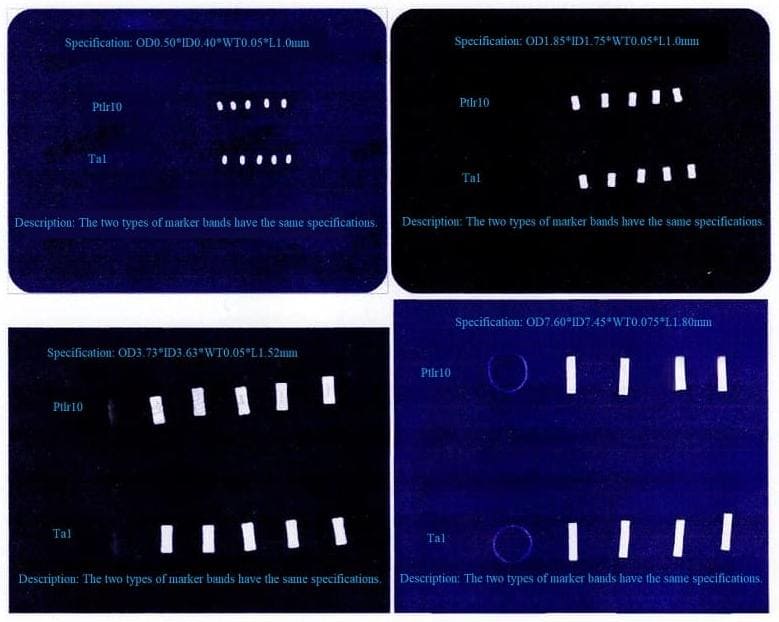
Tantalum and platinum-iridium are both used as radiopaque marker materials, but a material comparison is only a starting point. The final image depends on band geometry, the surrounding catheter materials, the distance and angle of the marker, imaging settings and the acceptance method. A supplier comparison image can support development discussions, but it should not replace validation on the actual device under the intended imaging conditions.
For that reason, request the test method and specimen description with any imaging result. Record the band dimensions, the catheter construction, the imaging setup and the acceptance criteria so that prototype and production lots can be compared consistently.
Dimensions, Tolerances and Edge Condition
For a ring or short tube, specify the dimensions that control fit and imaging exposure: OD, ID, wall thickness, length, concentricity or roundness where relevant, and the condition of the cut edges. Avoid copying a nominal value from a general product page into a controlled drawing. Instead, state the required value and tolerance on the drawing and ask the supplier to confirm feasibility for the selected material, form and quantity.
Small parts can be sensitive to burrs, distortion, scratches and handling damage. Define the visual standard and the inspection magnification or method when these features affect assembly. If the band is joined to a polymer or metal component, include the post-assembly dimensional check rather than inspecting only the loose band.
Choosing Tantalum or Platinum-Iridium
The choice between tantalum and platinum-iridium should be made against the complete design. Compare the required imaging performance, available geometry, forming and joining route, mechanical handling, chemical environment, surface requirements and documentation. Neither material should be described as universally superior without the same test conditions and the same device geometry.
Heeger Materials' tantalum marker band and platinum-iridium marker band pages can be used as starting points for a supplier discussion. Confirm the current product form, dimensions, tolerances and documentation for the specific quotation rather than assuming that a page-level description is a guaranteed specification.
Verification Before Design Release
- Review the drawing against the catheter assembly and identify every dimension that controls fit.
- Confirm the imaging test setup, specimen geometry and acceptance criteria.
- Inspect the loose band and the assembled component for burrs, scratches, deformation and displacement.
- Check that cleaning, packaging and handling requirements are defined for the intended downstream process.
- Keep material certificates, dimensional results and other requested records linked to the lot or sample under review.
- Do not infer MRI compatibility, finished-device biocompatibility or regulatory status from radiopacity alone; those questions require device-specific evaluation.
What to Include in a Tantalum Marker Band Inquiry
Send the supplier a drawing or a clear sketch together with the material preference, OD, ID, wall thickness, length, tolerance, edge condition, quantity, prototype or production status, assembly method, imaging requirement, inspection records and packaging or cleanliness requirements. If an alternative material is acceptable, state which performance and documentation requirements must remain unchanged.
For material background, see Heeger Materials' tantalum materials. For a quotation review, use the contact page and include the drawing and intended application context. This allows the technical discussion to focus on the actual component rather than a generic marker-band description.
Balloon catheters are medical devices extensively used in cardiology and vascular interventional procedures. They are typically made of soft materials and designed with one or more inflatable balloons that can be precisely positioned and expanded within the body to treat narrowed or blocked vessels. Marker bands are crucial components on balloon catheters, usually made of materials that are visible under X-ray. These marker bands are vital for ensuring correct balloon placement and inflation, enhancing the precision and safety of the procedure, and thereby improving clinical outcomes.
What is the evolution of the balloon catheter?
Early catheters were made from gold, silver, iron, and wood, and used purified butter as a lubricant. Over time, catheter technology underwent numerous innovations until the advent of the integrated catheter with a self-retaining balloon, which greatly advanced the development of balloon catheter technology.
The introduction of marker band technology marks a significant milestone in the evolution of balloon catheters. With advancements in medical imaging, the innovation of marker bands has allowed for precise visualization and positioning of catheters under X-ray or other imaging modalities. These bands, typically made of metals like platinum, iridium, or tantalum, not only improve the accuracy of procedures but also enhance safety, leading to better patient outcomes.
What is the marker band?
A marker band is an auxiliary tool used in surgical procedures, typically made of metallic materials such as gold, platinum, tantalum, iridium, or tungsten. They are installed on various medical devices like catheters, guidewires, stents, and implants to provide visual markers under X-ray or other medical imaging technologies, assisting doctors in accurately locating and tracking the device's position and orientation within the body.
What is the role of the marker band during a balloon catheter procedure?
The applications of marker bands in surgery
Marker bands distributed distal to the catheter, utilizing X-ray or ultrasound imaging technology, can display the markers on the catheter in real time during surgery. The position and shape of these markers help determine the extent of the balloon catheter's deployment and its relation to the surgical site.
The Impact of marker Bands on surgical outcomes
During the surgical procedure involving balloon catheters, marker bands are essential as reference points. The precision of these marker bands can significantly impact surgical outcomes because they affect the accuracy of the balloon's positioning. Moreover, the quality and application method of the marker bands are key factors that can enhance the surgery and contribute to the overall success of the intervention.
The imaging efficiency of the Tantalum Maker Band and Platinum Iridium (Pt10Ir) Marker Band
What is the future of the marker band?
In the future, the development of marker bands will focus on technological innovations and directions for improvement, which are expected to have a profound impact on the medical industry. With advancements in material science and engineering technologies, new marker bands will offer higher visibility and precision, enabling better positioning and navigation during surgeries. For instance, the use of nanotechnology and advanced alloys like tantalum and platinum-iridium could lead to marker bands that are more easily identifiable under X-ray or ultrasound imaging. Moreover, with the evolution of 3D printing technology, there might be customized marker band solutions to meet the needs of specific surgeries.
To learn more about tantalum marker bands, you can refer to the article “Exploring the Marvelous World of Medical Innovation: Tantalizing Tantalum Marker Bands”
Heeger Materials is a reputable supplier offering top-notch Tantalum Marker Band and Plantinum Iridium (Pt10Ir) Marker Band products at competitive prices, which are widely used in interventional medicine. If you're interested, feel free to reach out to us at [email protected] for a quote, and we guarantee a response within 24 hours.
FAQ
What is the main purpose of a tantalum marker band?
It provides a radiopaque reference point that can help locate a catheter or balloon under X-ray-based imaging. The final visibility depends on the band, the surrounding device and the imaging setup.
Which dimensions should appear on the drawing?
Typically define OD, ID, wall thickness and length, together with any applicable roundness, concentricity, edge-condition and surface requirements. The supplier should confirm achievable tolerances for the selected form and process.
Does radiopacity prove that a marker band is suitable for a finished medical device?
No. Radiopacity is one design requirement. Finished-device suitability also depends on the device design, processing, cleaning, packaging, verification and applicable quality or regulatory requirements.
Can the existing Ta and Pt10Ir image be used as a production acceptance test?
It can be a useful development reference, but a production acceptance test should use a defined method, controlled specimen geometry and agreed criteria that represent the actual device.