



If you need machinable boron nitride rods, plates, tubes, rings or crucibles, start with a supplier that can match the BN grade and blank or component geometry to your drawing. Heeger Materials' Boron Nitride (BN) Products category lists these product forms and links to individual pages for quotation requests. The practical next step is to send the required dimensions, tolerances, quantity and service conditions so the proposed material can be reviewed before purchase.
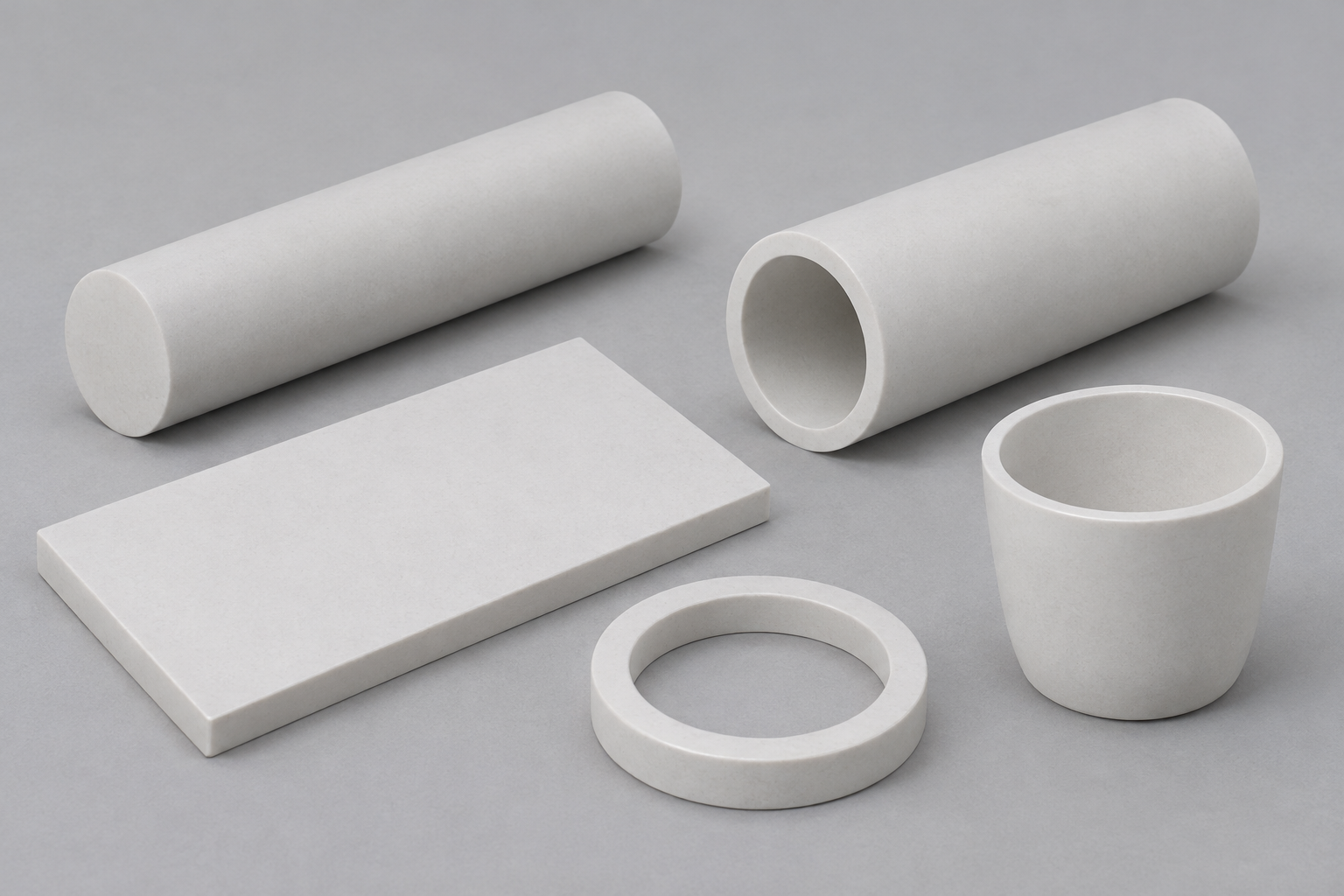
Where to source the five BN forms
Heeger Materials provides a direct starting point for technical buyers comparing BN shapes. The individual pages below are the verified product pages for the forms named in this article:
- Boron Nitride Rod for cylindrical blanks or rod-shaped components. Include the outside diameter, length, end condition and any drawing features in the inquiry.
- Boron Nitride Plate / Sheet for flat sections, shields, spacers or plates that may be machined to a final outline. State length, width, thickness, flatness, holes and edge requirements.
- Boron Nitride Tube for hollow cylindrical components. Provide outside diameter, inside diameter, wall thickness, length, concentricity and end geometry where relevant.
- Boron Nitride Ring for annular parts, spacers and other ring geometries. A sectional drawing is usually more useful than a product name alone because inner diameter, outer diameter and thickness control the fit.
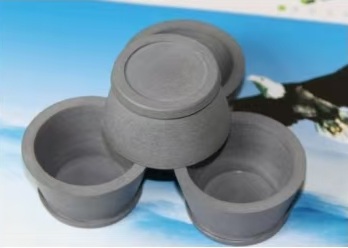
- Boron Nitride Crucible for vessels used in compatible thermal, laboratory or vacuum processes. Specify the opening, depth, wall thickness, lid or cover requirement and the material being processed.
What does "machinable boron nitride" mean?
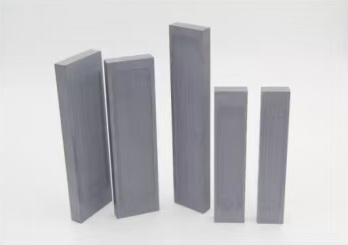
Machinable BN is not a complete specification by itself. In a sourcing request, it normally means that the buyer needs a BN ceramic blank or component that can be shaped, drilled, turned or otherwise finished with a suitable process. The feasible operation depends on the material grade, density, geometry, wall thickness, feature size, surface finish and the supplier's recommended processing method.
Ask the supplier to confirm whether the requested shape should be supplied as a near-net component, a larger blank for customer machining or a finished custom-machined part. Do not assume that a grade intended for one thermal or electrical environment will have the same machining behavior as another BN grade. If the part will see vacuum, an inert atmosphere, an oxidizing atmosphere, molten material or repeated thermal cycling, include those conditions with the drawing.
How to choose between rods, plates, tubes, rings and crucibles
Start with the load path and interfaces
Choose a rod when the design is fundamentally cylindrical or axial. Choose a plate or sheet when the key requirement is a flat barrier, support or shield. A tube is appropriate when the component must surround, guide or isolate another part. A ring is usually selected when an annular interface, spacer or opening is central to the design. A crucible should be specified as a vessel, with the charge, opening, depth, wall and cover requirements defined.
Define the operating environment
Tell the supplier the intended temperature range, atmosphere or vacuum level, thermal-cycle pattern, contact materials and contamination limits. Heeger Materials' BN category positions its ceramic products for high-temperature, insulation and vacuum-related work, but the suitability of a particular grade and geometry still has to be checked against the actual process.
Understand the BN family before specifying the grade
For a material inquiry, begin by separating conventional hexagonal boron nitride (h-BN) from composite boron nitride ceramics. Heeger Materials lists hexagonal boron nitride products for custom shapes, sizes and grades, with high-temperature, lubrication and electrical-insulation use cases. That category is a useful starting point when the design calls for a BN-rich ceramic and the final form may be a rod, plate, tube, ring, crucible or custom part.
Do not treat "boron nitride" as a complete material specification. Ask whether the quote is for an h-BN grade, a BN-based composite, or a conductive grade, and request the applicable composition, density, electrical behavior, thermal data and chemical-compatibility information. The same geometry can behave differently when the matrix or additive phase changes.
Common boron nitride composite ceramics to compare
- BN-BO: Heeger identifies this as B2O3-bonded boron nitride ceramic made using BN and boric oxide (B2O3). If this grade is being considered, confirm the required Grade A designation, composition limits, operating atmosphere and compatibility with the process material.
- ALBN or BN-AlN: This is listed as an aluminum nitride-boron nitride ceramic. Because the product combines BN and AlN, the inquiry should state whether thermal conductivity, electrical insulation, thermal expansion or another property controls the selection, and should request the grade-specific data sheet.
- ZSBN: Heeger lists ZSBN as a boron nitride composite ceramic and notes that custom specifications and technical support are available. The product name alone does not define the full composition, so request the supplier's current technical data before assigning a service temperature or machining route.
- BN-T conductive ceramic: The project datasheet identifies BN-T as a composition of BN + TiB2 + AlN and describes forms including crucibles, evaporation boats, plates and custom machined parts. It is therefore a distinct conductive composite rather than an interchangeable substitute for insulating h-BN. Confirm resistivity, atmosphere, temperature, contamination limits and machining requirements for the specific part.
For any composite, specify the tradeoff you need to control: electrical conductivity versus insulation, thermal transport versus thermal expansion, chemical compatibility versus ease of machining, or a near-net shape versus a machinable blank. Ask for the composition and test conditions behind each quoted value, because a number without its grade, atmosphere, temperature and test method is not a reliable basis for comparing BN ceramics.
Separate material requirements from geometry requirements
Material requirements may include BN phase or composite designation, composition, purity or impurity limits, density, electrical behavior, thermal expansion, thermal conductivity, service atmosphere and chemical compatibility. Geometry requirements include dimensions, tolerances, flatness, concentricity, surface finish, holes, slots, threads, chamfers and edge treatment. Keeping these two groups separate helps the supplier identify what must be guaranteed on the material certificate and what must be inspected on the finished part.
What to include in a boron nitride quotation request
A complete inquiry lets a technical supplier respond with fewer assumptions. Include:
- the form: rod, plate or sheet, tube, ring, crucible, blank or custom part;
- a dimensioned drawing or a complete dimension list, including tolerances and critical features;
- the BN grade or composition required, if already defined;
- operating temperature, atmosphere or vacuum, thermal cycling and contacting materials;
- surface finish, flatness, concentricity, edge, hole or thread requirements;
- quantity, sample or production status, packaging needs and requested documentation; and
- the application context, especially when electrical insulation, contamination control or compatibility with a melt is important.
For a quotation, contact Heeger Materials with the drawing and operating conditions. The product pages also provide a useful way to begin with the exact form: browse the BN product category, then select the rod, plate, tube, ring or crucible page that matches your design.
FAQ
Can I buy boron nitride rods, plates, tubes, rings and crucibles from one supplier?
Heeger Materials' BN product category currently links to individual pages for rods, plates or sheets, tubes, rings and crucibles. Confirm the exact grade, dimensions, quantity and documentation for each form in the quotation request.
Does "machinable" mean every BN grade can be machined in the same way?
No. Machining behavior depends on grade, density, geometry and the required feature or finish. Ask whether the supplier recommends a blank, a near-net component or a finished custom-machined part for the specific design.
What drawing details matter most for a BN tube or ring?
For a tube, specify outside diameter, inside diameter, wall thickness, length, concentricity and end geometry. For a ring, specify inner and outer diameters, thickness, flatness, edge treatment and any grooves or holes.
How do I request a boron nitride crucible quote?
Send the crucible drawing or dimensions together with the opening, depth, wall thickness, cover requirement, material being processed, atmosphere, temperature range, quantity and documentation needs.
Note: Product form, grade, dimensions, tolerances, availability and documentation should be confirmed for each order. Product images in this article are for form reference and do not replace a drawing or technical quotation.