



Quick answer: For the most demanding wet-acid chemical processing duties, commercially pure tantalum often provides the largest corrosion-resistance margin. Niobium can be the more practical choice when lower density, easier forming, lower material cost or a particular mechanical requirement matters. Common alloys change the decision: Ta-2.5W and Ta-10W add strength while retaining much of tantalum's chemical-resistance value, while Nb-1Zr and C103 address strength or high-temperature needs that pure niobium cannot meet alone.
There is no universal winner. The correct choice depends on the actual process fluid, concentration, water content, temperature, flow, pressure, impurities, welding condition and required service life. This guide compares pure tantalum, pure niobium, typical tantalum alloys and typical niobium alloys for reactors, heat exchangers, liners, tubing, condensers and other corrosion-resistant chemical processing equipment.
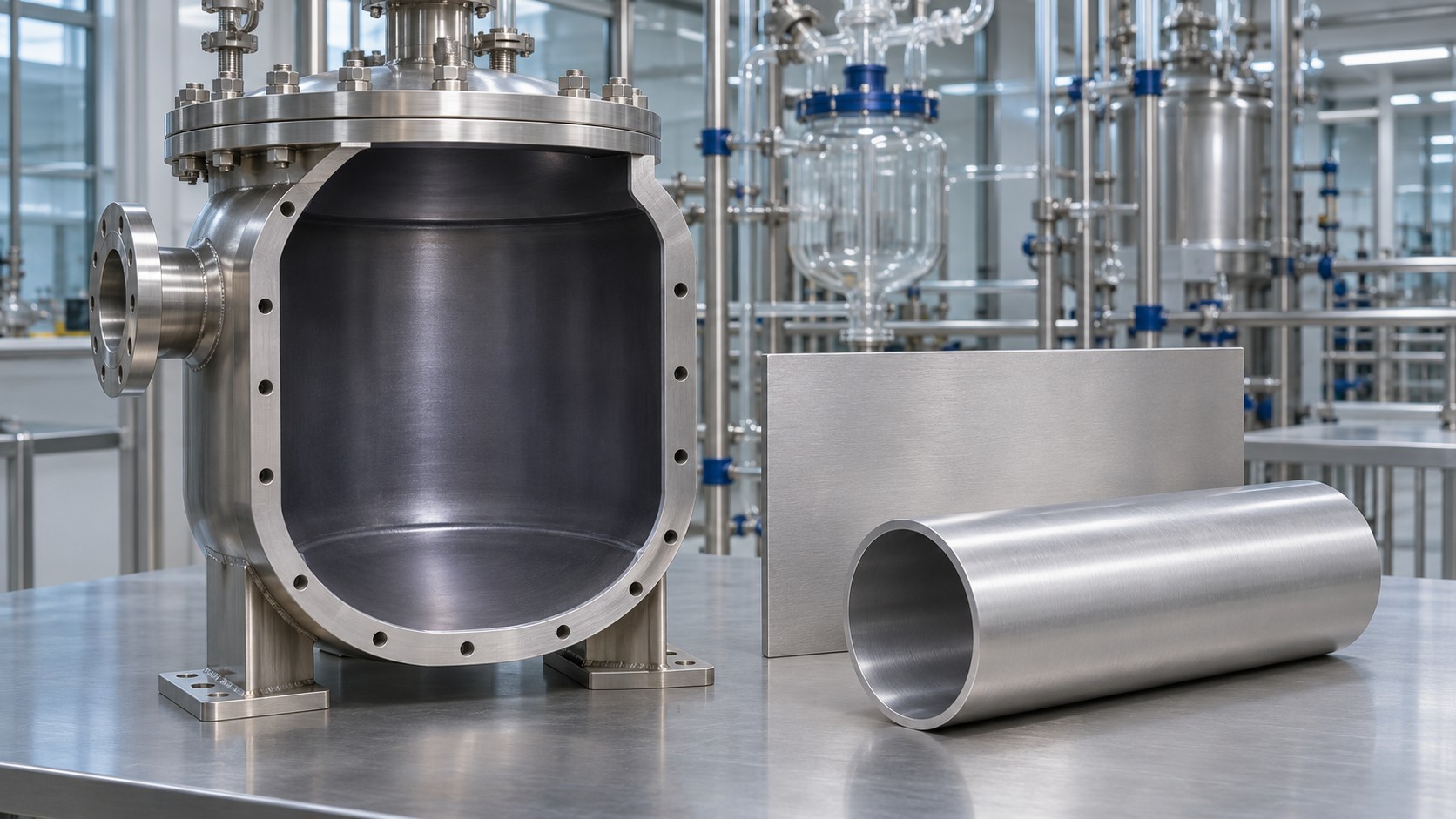
When is tantalum the better choice than niobium?
Tantalum is usually the stronger candidate when corrosion resistance is the primary design driver and the equipment will contact aggressive mineral acids under conditions known to be compatible with tantalum. Tantalum's stable passive film supports its use in selected hydrochloric-acid, sulfuric-acid, nitric-acid and mixed-acid services, but compatibility is never determined by acid name alone. Concentration, temperature, aeration, contaminants and heat-transfer conditions can change the result.
For a high-consequence process, the practical question is not whether tantalum is “corrosion resistant” in general. It is whether the specified grade, weld zone, surface condition and joint design remain within the allowable corrosion envelope for the complete duty cycle. Tantalum is also dense and comparatively expensive, so a thin tantalum lining or tantalum-clad construction may be considered when a full solid-tantalum vessel would be unnecessarily heavy or costly. The lining design must prevent local exposure of the backing material.
When can niobium or a niobium alloy be the better choice?
Niobium is attractive when the equipment needs a lower-density refractory metal, good ductility, a specific forming response or a more economical alternative to tantalum in a qualified chemical environment. Pure niobium can perform well in selected corrosive services, but its usable range is more sensitive to the exact chemistry and temperature than a broad “niobium is corrosion resistant” statement suggests.
Niobium alloys are generally selected for a reason other than maximum wet-acid resistance. Nb-1Zr, for example, is used when a small zirconium addition is needed to improve high-temperature strength or stability relative to unalloyed niobium. C103, a niobium alloy containing hafnium and titanium, is primarily a high-temperature structural alloy. It can be relevant to heated hardware, but it should not be substituted automatically for a tantalum chemical-process lining. Alloying, heat treatment, welding and exposure conditions must be assessed together.
Review the niobium metal and alloys category and the niobium and niobium alloys guide for broader product and specification context.
Pure tantalum, tantalum alloys, pure niobium and niobium alloys
The material family should be narrowed before a design comparison is made. “Tantalum” and “niobium” can each describe multiple grades, product forms and processing states.
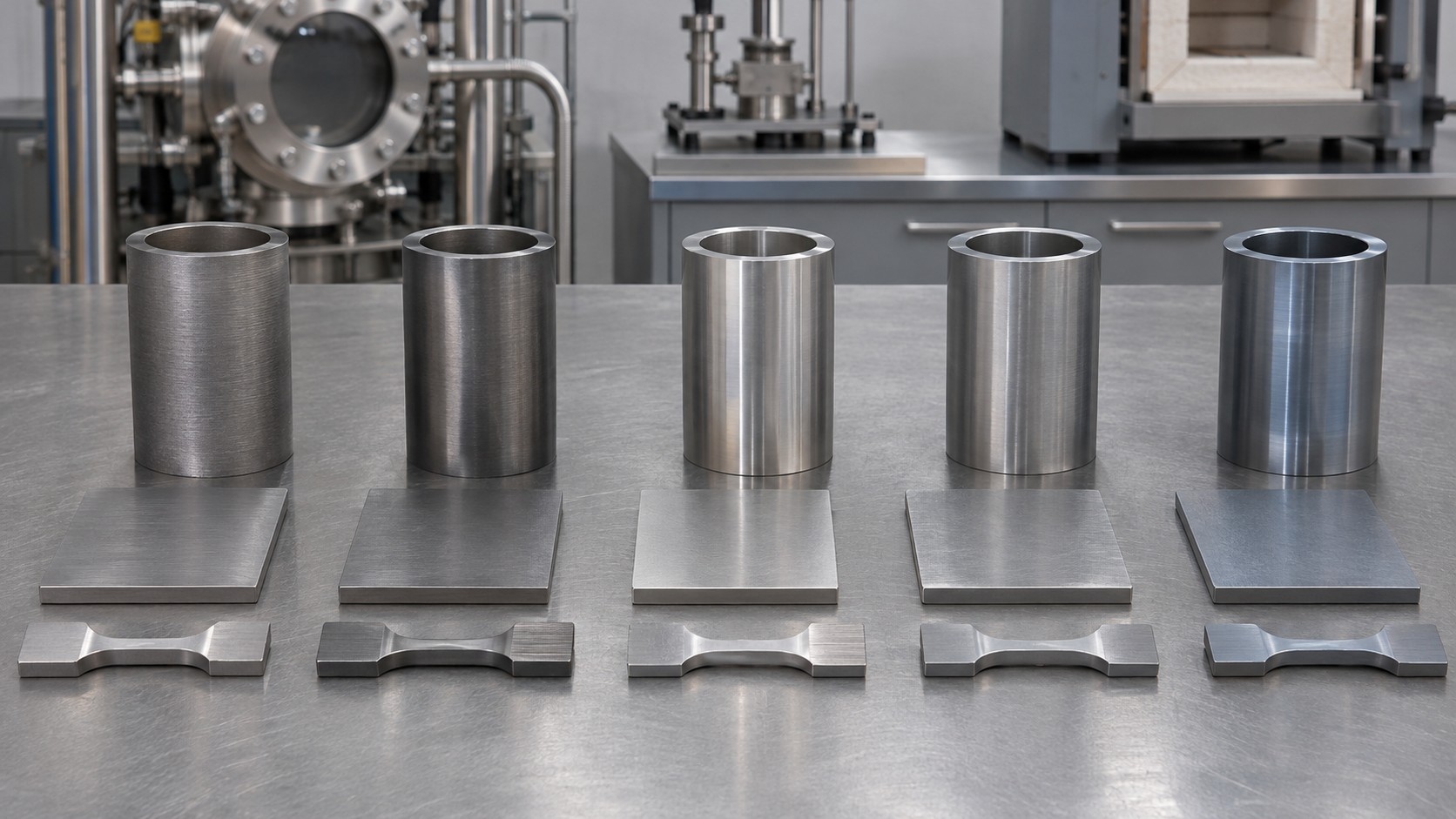
| Material family | Why engineers consider it | Important caution for chemical equipment |
|---|---|---|
| Commercially pure tantalum | Very high resistance in many strongly corrosive wet-acid services; good ductility and fabricability in suitable forms | High density and cost; verify the exact acid, concentration, temperature, impurities, welds and backing or lining design |
| Ta-2.5W and Ta-10W | Higher strength than unalloyed tantalum for thin sections, elevated temperature or mechanically demanding parts | Do not assume alloying preserves every corrosion result of pure tantalum; qualify the grade and welded condition for the process fluid |
| Ta-40Nb | Combines tantalum and niobium in a specialized alloy family where a combined property set is required | Use the product specification and application evidence for the actual composition; it is not interchangeable with pure Ta or pure Nb |
| Commercially pure niobium | Lower density, good ductility and useful performance in selected corrosive or high-temperature applications | Compatibility is more condition-specific; verify temperature, oxidizing potential, concentration and contaminants |
| Nb-1Zr | Improved high-temperature strength or stability relative to unalloyed niobium in selected designs | Strength improvement does not establish wet-chemical compatibility; obtain alloy-specific data |
| C103 niobium alloy | High-temperature structural performance and good weldability in qualified aerospace or thermal applications | Usually a structural high-temperature alloy, not a default choice for aggressive wet-acid process contact |
Heeger Materials lists tantalum alloy sheet and tantalum alloy rod product forms, including pure tantalum and selected Ta-W or Ta-Nb grades. Confirm the current grade, standard, condition, dimensions and documentation before treating a catalogue option as a process specification.
How do the metals compare in common chemical-processing environments?
Hydrochloric and other chloride-bearing acids
Chloride concentration, temperature, oxygen level and oxidizing contaminants are critical. Tantalum is often investigated first for severe hydrochloric-acid duties, but a real design still requires a corrosion table or test relevant to the process. Niobium and niobium alloys should be screened against the same conditions rather than rejected or accepted from a generic material label.
Sulfuric acid and mixed-acid service
Acid concentration and temperature can create sharply different corrosion regimes. Heat-transfer surfaces, dilution points, wet-dry interfaces and deposits deserve separate attention. Tantalum may offer a useful margin in selected sulfuric-acid equipment, while niobium may be suitable only in a narrower qualified envelope.
Nitric acid and oxidizing media
Oxidizing conditions can support passivation, but the full chemistry still matters. Review impurities, fluorides, chlorides, flow velocity, crevices and weld quality. Never transfer a result from pure tantalum to Ta-W, Ta-Nb or a niobium alloy without confirming the alloy and test conditions.
Alkaline, fluoride-containing or specialty process fluids
Fluoride, hydrofluoric acid, molten salts and strongly alkaline solutions can alter the normal passive-film assumptions. These services require process-specific compatibility data and may eliminate an otherwise attractive refractory metal. A small concentration of a critical contaminant can control the outcome.
Does the equipment design change the material decision?
Yes. A material that is suitable as a coupon may be unsuitable as a fabricated vessel if the design creates crevices, galvanic couples, thin unsupported sections or difficult weld geometries.
- Reactors and vessels: Check wall thickness, thermal gradients, agitation, pressure, nozzle details, weld access and whether solid metal, cladding or a liner is intended.
- Heat exchangers: Review tube-to-sheet joints, differential expansion, deposits, velocity, erosion-corrosion and local dilution at inlets.
- Pipe, tubing and fittings: Specify internal surface condition, bends, joints, dead legs, flange materials and inspection access. Heeger offers niobium tube and related refractory-metal forms for review.
- Liners and cladding: Define backing material, bond integrity, repair method, allowable pinholes and inspection method. A liner is only protective if the process cannot reach the backing metal.
- Evaporators and condensers: Include vapor-phase chemistry, condensate composition, start-up and shutdown conditions, and any concentration changes caused by phase change.
Strength, fabrication and cost: where alloys matter
Alloying is often used to solve a mechanical or thermal problem, not to create a universal corrosion upgrade. Tungsten-bearing tantalum grades can increase strength, which may allow a thinner or more stable part. Niobium-zirconium and C103 can improve high-temperature structural behavior in defined applications. Those gains must be weighed against forming, machining, welding, residual stress, inspection and the possibility that the corrosion data for the alloy are less extensive than for commercially pure tantalum.
Tantalum's density can affect lifting, support, rotating equipment and total installed weight. Niobium's lower density can be useful for larger parts, but a lower material price does not by itself reduce total cost if the design needs thicker sections, a special liner, more frequent inspection or tighter process qualification. Compare total lifecycle risk, not only the price per kilogram.
A practical selection workflow
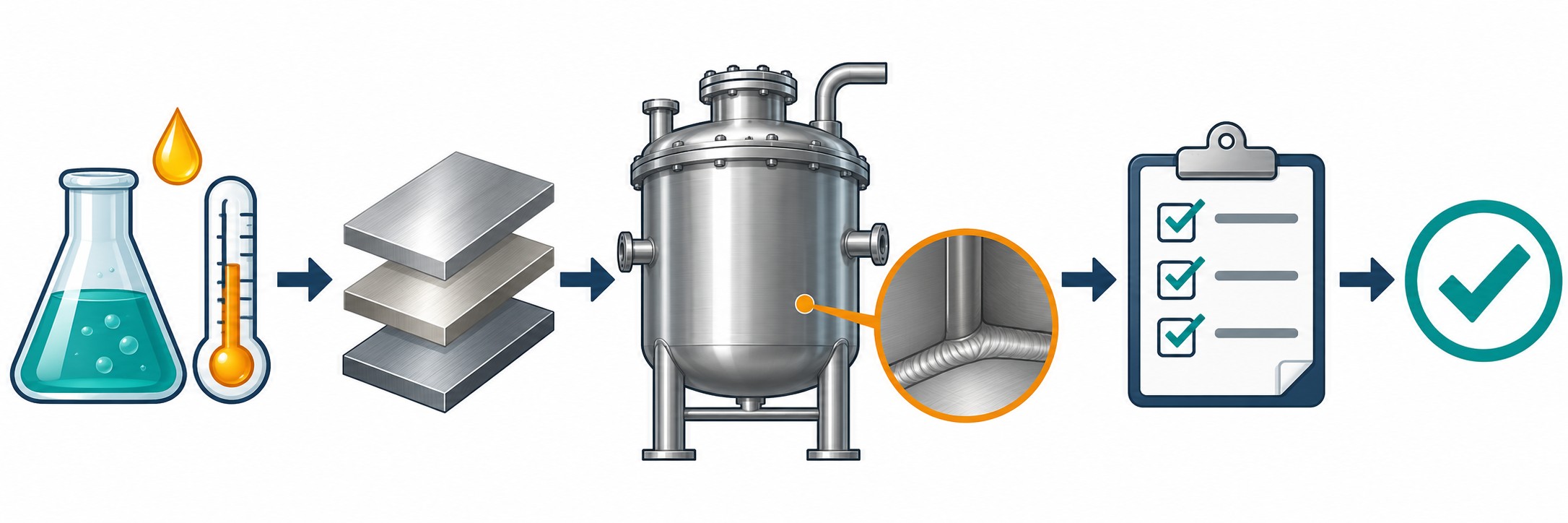
- Define the process chemistry: List every major component, concentration range, water content, impurities, dissolved gases, solids and cleaning chemicals.
- Define the duty cycle: Record minimum and maximum temperature, pressure, flow, thermal cycling, start-up, shutdown and upset conditions.
- Screen the material family: Compare pure Ta, Ta-W, Ta-Nb, pure Nb, Nb-1Zr and C103 only where the grade has relevant evidence.
- Separate corrosion from strength: Select corrosion compatibility first, then check thickness, creep, fatigue, forming and weld requirements.
- Choose the construction route: Decide between solid material, liner, clad construction, replaceable insert or a different compatible alloy.
- Qualify fabrication: Review welding procedure, joint design, cleaning, heat input, contamination control, inspection and repair limits.
- Request documentation: Ask for chemistry, grade, standard, condition, dimensional inspection, surface requirements and any application-specific corrosion evidence.
What should be included in a quotation request?
A useful inquiry should make the service environment as explicit as the material name. Include:
- Material family and grade, such as R05200, R05400, Ta-2.5W, Ta-10W, Ta-40Nb, pure Nb, Nb-1Zr or C103
- Product form, drawing, dimensions, wall thickness, tolerances and surface finish
- Process fluid, concentration range, temperature range, pressure, flow and contaminants
- Solid, lined or clad construction, backing material and joint or weld requirements
- Thermal cycling, start-up and shutdown conditions, cleaning chemistry and expected service life
- Applicable standards, inspection reports, chemical analysis, traceability and packaging requirements
For an alloy-specific review, compare the tantalum products category with niobium metal and alloys, then send the operating conditions with the drawing. The existing comparison of niobium with other refractory metals provides broader context, while the tantalum and tantalum alloys guide covers standards and product-selection considerations.
FAQ
Is tantalum always better than niobium for chemical processing equipment?
No. Tantalum often has the larger corrosion-resistance margin in severe wet-acid service, but niobium can be a better fit when the chemistry is qualified and lower density, forming or cost matters. The correct answer depends on the complete service envelope.
Are Ta-2.5W and Ta-10W automatically more corrosion resistant than pure tantalum?
No. These alloys are commonly considered for higher strength, but corrosion performance must be confirmed for the specific alloy, process fluid, temperature, weld condition and surface state. Do not assume that a strength improvement is also a corrosion improvement.
Is Nb-1Zr a direct substitute for tantalum?
Not as a general rule. Nb-1Zr may provide a useful high-temperature or stability advantage over pure niobium, but it does not establish the same wet-chemical compatibility as tantalum. Use alloy-specific corrosion evidence and a process test where the consequence of failure is high.
Is C103 suitable for a hydrochloric-acid reactor liner?
C103 is primarily known as a high-temperature niobium alloy for structural applications. It should not be selected as a hydrochloric-acid liner without specific compatibility data for the acid concentration, temperature, impurities, welds and exposure time.
Should I choose a solid tantalum vessel or a tantalum-lined vessel?
That depends on pressure, temperature, geometry, backing-metal compatibility, lining attachment, repairability, inspection and lifecycle cost. A lined design can reduce weight or material usage, but it requires reliable protection against pinholes, damage and local exposure of the backing material.
What is the most important information for a material recommendation?
Provide the full chemical composition, concentration range, temperature and pressure, water and impurity content, flow or agitation, thermal cycle, equipment geometry, fabrication method and required service life. A material name alone is not enough for a corrosion-resistant equipment recommendation.
For a drawing-based comparison of tantalum, tantalum alloys, niobium or niobium alloys, contact Heeger Materials with the process conditions and documentation requirements.